Plasma vs Ionic Hair Dryers: What Importers Actually Notice
A factory-direct comparison of plasma vs ionic hair dryer technology for B2B importers — covering moisture retention, hair-type fit, OEM specs, and retail positioning.
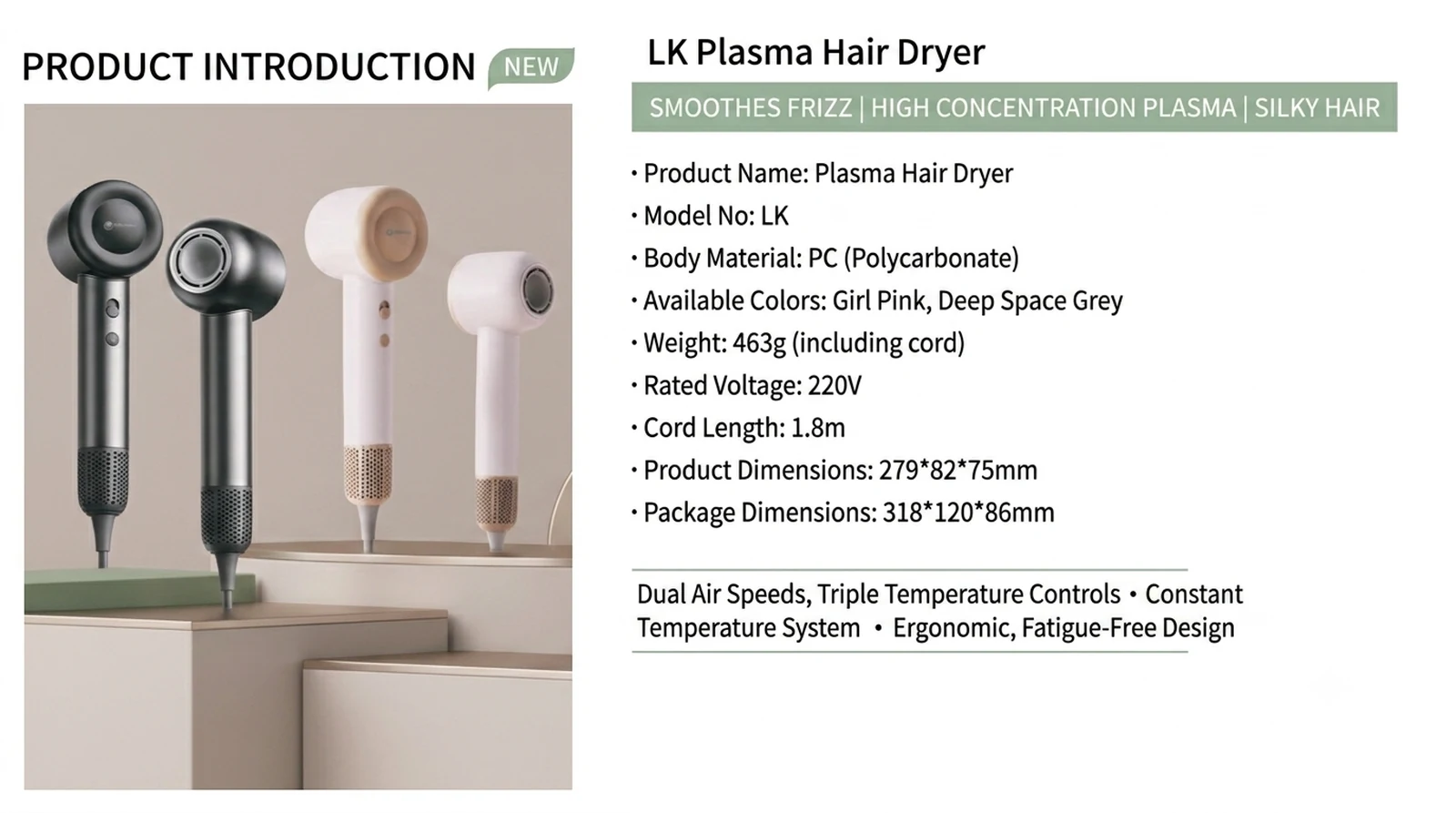
Walk into any hair care trade show and the plasma-vs-ionic argument is already playing out on the showroom floor. For B2B importers sourcing from a personal care appliance OEM, the difference between these two technologies shapes everything from packaging claims to retail tier. Both rely on charged particles, but how those particles interact with wet hair and the surrounding air creates distinct end-user results. Understanding the science — and the marketing — is the first step in choosing a hero SKU.
How Plasma Ion Generation Actually Works
A plasma hair dryer uses a high-voltage emitter at the nozzle or within the air pathway to ionize water molecules in the surrounding air stream. The result is a mix of positive and negative ions — heavier than the single-polarity outputs typical of ionic-only devices — that interacts with the wet hair cuticle as air passes through. The technology is sometimes called "plasma ion" or "bipolar ion" in retail copy, but the engineering principle is the same: produce both ion polarities at concentrations higher than a standard ionic generator can sustain.
For an OEM/ODM factory, the difference is component count. A plasma module typically requires an additional emitter circuit, a high-voltage transformer, and insulation rated for the discharge path. The benefit claimed by brands is faster moisture breakdown at lower sustained heat — the hair cuticle closes faster, reducing the frizz that comes from prolonged exposure to warm air.
From an importer's perspective, the story to tell consumers is "faster drying with less heat damage." The reality is closer to "moisture is removed more efficiently, so the dryer can complete the job at a lower temperature setting." The distinction matters because retail copy that overstates plasma's effects tends to attract warranty scrutiny in regulated markets.
What "Ionic" Hair Dryers Have Always Meant
Ionic technology has been a retail fixture for nearly two decades. A traditional ionic dryer uses a corona discharge or heated metal element to emit a single-polarity stream — usually negative ions — that neutralizes positive static charges on the hair surface. The effect is reduced frizz, smoother cuticle lay, and a small reduction in drying time because water molecules are broken into smaller clusters that evaporate more readily.
The technology is mature, the components are inexpensive, and the certification pathway is well-trodden. For an OEM in Dongguan, an ionic hair dryer is a straightforward build: motor, heating element, ionic emitter module, housing, control PCB. Margins are tighter because the category is crowded and the technology is no longer a meaningful differentiator at the entry tier.
The ceiling for ionic-only positioning in retail is therefore lower. A buyer looking to launch a new SKU needs either a true technical edge or a category-defining price point to win shelf space against the established ionic brands. In mature markets, ionic is the new baseline — buyers expect it as standard rather than a premium feature.
Moisture Retention and Cuticle Behavior
This is where the two technologies diverge most visibly in consumer testing. Plasma ion output, being bipolar, is said to interact with the hair shaft more thoroughly — closing the cuticle layer along more of its length and locking in internal moisture. Ionic-only output handles surface static but does not affect the deeper moisture profile.
In practical terms, a salon professional using both dryers back-to-back will notice that plasma-treated hair holds a style longer in humid conditions and shows less flyaway after brushing. The difference is most visible on coarse, curly, or color-treated hair, which is also the demographic most willing to pay for premium tools.
For importers targeting the professional and prosumer segment, plasma's moisture story maps directly to retailer demand. For volume retail — drugstore, mass-market, discount — the ionic story is still adequate and the cost structure is friendlier. The choice therefore cascades into packaging, influencer selection, and channel placement from day one.
What End Consumers Actually Feel
Marketing claims aside, the sensory experience of the two technologies differs in measurable ways. Plasma dryers tend to run cooler at the nozzle for the same drying result, because efficiency gains mean the heating element can throttle down. Consumers report less heat discomfort on the scalp, faster dry times on shoulder-length hair, and a smoother finish without serum.
Ionic dryers do most of these things too, but with a smaller delta versus a non-ionic baseline. Consumers switching from a basic dryer to an ionic model see a clear upgrade. Consumers switching from ionic to plasma see a smaller incremental improvement — but it is the increment that justifies the step-up SKU in retail.
For a brand manager building a portfolio, the practical question is whether the upgrade is perceptible enough to defend a price ladder. On European and North American shelf, the answer is generally yes for the pro tier. In Southeast Asia and Latin America, ionic often remains the dominant claim because the price-sensitive buyer is making a single jump from non-ionic to ionic, not ionic to plasma.
Hair Type Compatibility Across Regional Markets
Hair type is a regional story. East Asian consumer markets skew toward fine, straight hair where frizz control is less of a pain point. European and North American markets have higher proportions of curly, coily, and color-treated hair where plasma's moisture profile delivers visible benefit. Middle Eastern and Latin American markets often sit between these two extremes.
An OEM/ODM partner should map the target retail market before committing to a plasma hero SKU. The same factory line can produce both technologies, but the marketing assets, packaging, and influencer strategy must match the demographic. A plasma dryer sold in a market where the hair type does not deliver the claimed benefit will generate returns faster than a comparable ionic SKU.
This is also why some global brands run parallel product lines — an ionic hero for one region and a plasma hero for another — rather than trying to standardize a single global SKU. The tooling is shared, but the SKU strategy diverges by channel.
Motor, Element, and Component Considerations
The bill of materials differs in three areas. First, the high-voltage plasma emitter circuit, including the transformer and any shielding required to keep the discharge inside the air path. Second, the heating element, which on plasma dryers is often a thinner-gauge coil because the dryer is designed to operate at lower sustained temperatures. Third, the control PCB, which needs additional logic to manage the emitter output in coordination with the temperature and airflow settings.
For an OEM/ODM with 150,000+ units/month capacity, the component sourcing is straightforward. Lead time for the plasma emitter is typically two to four weeks versus one to two weeks for a standard ionic module. For a first-time importer, this means a slightly longer production cycle but no structural supply chain risk.
Tooling cost between the two variants is similar because the housing, motor mount, and rear grilles are typically shared. The plasma variant simply adds the emitter assembly and the wiring harness to route the high-voltage lead into the air path.
Noise, Weight, and Ergonomic Trade-offs
Plasma dryers tend to be marginally heavier because of the emitter hardware. The added weight is usually under 50 grams, but it concentrates at the nozzle where the high-voltage circuit lives. Ergonomically, this shifts balance forward, which some users prefer and others do not. Industrial designers often compensate by adjusting the rear housing geometry or adding a soft-touch grip insert.
Noise output is similar across both technologies at equivalent motor speeds. The differentiator is often the motor itself — a high-speed brushless motor delivers both technologies at lower noise than a brushed motor can. For premium positioning, motor choice matters more than the plasma/ionic choice.
For an importer deciding between technologies, the engineering checklist should weight motor specification more heavily than emitter specification at the premium tier. A quiet ionic dryer with a brushless motor will out-review a loud plasma dryer with a brushed motor every time.
Certification and Compliance Routes
Both plasma and ionic hair dryers fall under the same electrical safety and EMC frameworks. CE, FCC, UKCA, RoHS, and REACH apply equally. The plasma emitter does not change the regulatory category of the product, but it does require additional EMC testing because the high-voltage discharge is an intentional emitter of broad-spectrum noise.
An experienced OEM helps the importer plan the certification path in parallel with tooling, which compresses the launch timeline. For European retail, the typical sequence is CE first, then UKCA after UK distribution is confirmed. For North American retail, FCC and ETL or UL listings run in parallel with tooling.
Documentation also matters. A retail buyer at a major chain will ask for test reports, declaration of conformity, and material disclosure sheets. An OEM/ODM partner that has shipped the same product family into Europe or North America can supply these from existing files, which shortens the importer's onboarding window.
Retail Tier Positioning and Brand Storytelling
Plasma sits naturally in the pro and prosumer tier. Ionic spans entry to mid-tier, with high-end ionic dryers competing against entry plasma units. The retail narrative for plasma should emphasize technology, time savings, and hair health. The narrative for ionic should emphasize reliability, value, and broad consumer fit.
For an importer building a portfolio, a common pattern is to launch an ionic SKU at MOQ 500 to test market response, then add a plasma SKU at MOQ 500 in the second production cycle. This staged approach spreads capital risk and lets the retail channel validate the category before committing to the higher-spec SKU.
Brand storytelling also differs. Plasma claims benefit from technical depth — block diagrams, ion count, and lab data. Ionic claims work better with lifestyle imagery and salon endorsements. As retail channels continue to consolidate and shelf space tightens, the packaging, website copy, and influencer selection should align with whichever narrative the retailer needs — and that decision typically needs to be made before tooling locks.
Related Articles
For deeper coverage of the OEM/ODM development process, see our plasma hair dryer OEM guide. For the wholesale buyer's perspective on category positioning, the ionic technology explainer on gaborhub.com covers how retail channels evaluate these claims when placing orders.