How Hair Dryer Temperature Control Shapes Salon Adoption — OEM Guide
Explore why precise temperature control drives professional salon adoption of high-speed hair dryers and what B2B importers should evaluate when sourcing OEM units.
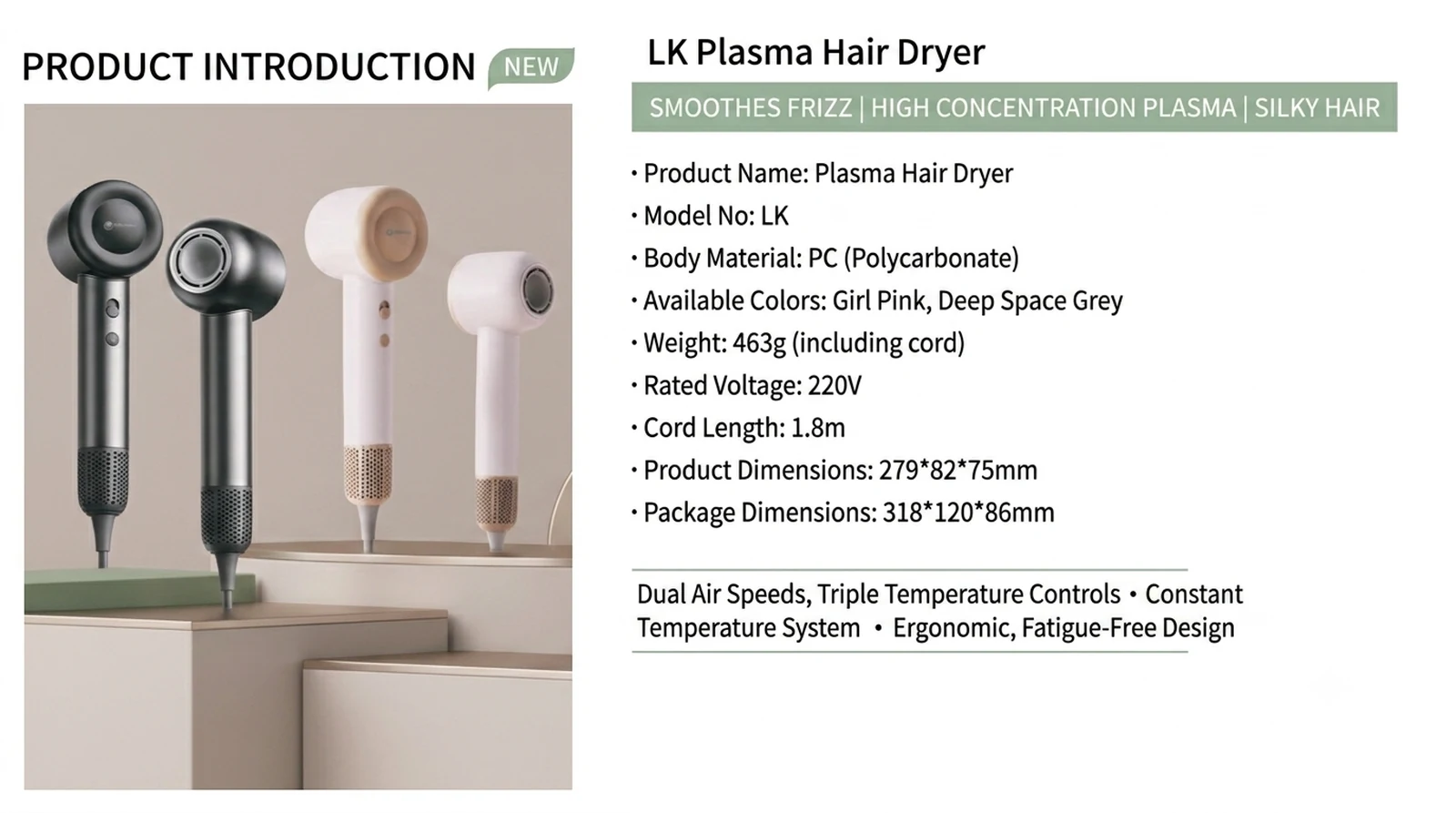
When a stylist reaches for a blow dryer behind the chair, the decision is rarely about brand decals or box artwork. It is about how the tool behaves during a 40-minute color service, a 15-minute express blowout, or a back-to-back Saturday rush. Temperature behavior sits at the very center of that decision, which is why OEM buyers targeting the professional channel increasingly treat thermal engineering as the headline specification rather than an afterthought. Understanding how hair dryer temperature control actually shapes adoption helps importers position products that stylists will keep on the counter for years, not weeks.
Why Temperature Control Defines Salon-Grade Hair Dryers
Professional stylists judge tools the way mechanics judge wrenches: by feel, by repeatability, and by what fails first. A dryer that runs hot enough to seal a cuticle in one pass but cool enough to avoid scorching fine hair is the kind of tool that earns shelf space in a busy salon. Inconsistent heat, on the other hand, is one of the fastest paths to returns and negative word-of-mouth in the professional channel.
For importers, this means temperature control is not just a comfort feature. It directly influences stylist satisfaction, end-client repeat visits, and ultimately the volume of repeat orders flowing back through distribution. A unit that maintains stable output across a full eight-hour shift creates fewer complaints, fewer warranty claims, and more upsell conversations at the front desk.
The Science of Heat, Keratin, and Cuticle Behavior
Hair is a protein structure built from keratin, and keratin begins to denature somewhere around 150 °C depending on moisture content and prior chemical treatment. The outer cuticle scales open under heat and moisture and then re-seal as the strand cools. The faster and more evenly a dryer can deliver that transition, the smoother the finished result.
The challenge for tool designers is that the strand is rarely uniform. Root sections are denser, mid-lengths hold more water, and ends are older, drier, and more porous. A single fixed-temperature output cannot serve all three zones well. This is where intelligent thermal management — combining a high-speed brushless motor with a real-time thermistor loop — separates professional units from consumer-tier dryers. Our B2B guide to high-speed hair dryer OEM specs walks through the engineering details importers often overlook.
Smart Sensors vs. Fixed Heat Output
Entry-level dryers typically rely on a bimetal strip or a simple NTC thermistor with a fixed cutoff. That architecture works for light home use but cannot hold a steady outlet temperature under varying airflow demands. When a stylist switches from a coarse brush to a fine nozzle, the back-pressure changes, the motor load shifts, and a fixed-output dryer will spike or sag accordingly.
Closed-loop temperature control closes that gap. A thermistor placed in the airflow path feeds back to the control board 50 to 100 times per second, adjusting heater duty cycle in real time. The user-facing result is a tool that holds roughly the selected temperature within a narrow band even as airflow changes. For OEM buyers, asking about loop frequency, sensor placement, and heater response time is far more informative than reading wattage numbers on a spec sheet.
Stylist Workflow Benefits of Consistent Heat
A stylist running back-to-back blowouts does not want to babysit a thermostat. Consistent thermal output translates into predictable timing: a Brazilian blowout takes the same number of passes today as it did yesterday, which means appointments stay on schedule and product usage stays within budget.
It also reduces fatigue on the operator's wrist and forearm. When the tool does the temperature management automatically, the stylist no longer has to cycle between hot and cool settings to avoid damage. That ergonomic dividend is one of the quieter selling points in salon-channel marketing, but it consistently shows up in repeat-purchase surveys from professional buyers.
Plasma Technology and Temperature Stability
Plasma-assisted drying introduces a stream of negatively charged ions and reactive species into the airflow. The immediate consumer-facing claim is faster drying and reduced frizz, but the deeper engineering effect is on heat distribution. Because plasma disrupts the boundary layer of water molecules clinging to the hair shaft, the strand reaches the desired moisture level faster — and therefore requires less total heat exposure.
For OEM partners, this means a plasma module paired with closed-loop thermal control can deliver visible smoothness at outlet temperatures a conventional dryer would struggle to match. The LK Plasma Hair Dryer platform was developed around that exact pairing, which is why the unit reads as a professional tool rather than a consumer upgrade. Importers evaluating plasma claims should ask whether the plasma generator is integrated into the airflow path or mounted externally, because the difference is significant in both performance and assembly cost.
Color-Treated Hair and Temperature Precision
Color-treated and chemically processed hair is more vulnerable to heat damage than virgin hair. Bleached strands in particular have a higher porosity and a lower denaturation threshold, so a dryer that runs 10 to 15 °C hotter than necessary can undo the work of an entire color service in a single finishing pass.
This is why many high-end salons now specify dryers with multiple temperature stages and a clearly labeled cool-shot. The cool-shot is not just for setting style — it is the operator's emergency brake when working on compromised hair. OEM buyers serving the color-specialist segment should treat a true sub-30 °C cool shot, not a "cool" setting that is merely lukewarm, as a non-negotiable feature.
What B2B Importers Should Evaluate in Thermal Specs
A spec sheet that lists only maximum wattage and a handful of generic mode names tells importers very little about real-world performance. The specifications that matter in professional procurement conversations are: measured outlet temperature at the nozzle under load, temperature drift across a 10-minute continuous run, sensor loop frequency, and cool-shot minimum temperature.
Equally important is how the unit performs at low airflow. Many dryers pass thermal tests at full blast but overheat when the user attaches a diffuser or concentrator that restricts flow. Requesting a test report that includes restricted-flow measurements gives importers a much clearer picture of how the tool will behave in actual salon hands.
Compliance and Certification for Heated Appliances
Heated personal care appliances fall under stricter regulatory scrutiny than unpowered tools, and the certification pathway varies by destination market. CE, UKCA, FCC, RoHS, and REACH are commonly required for Europe, the United Kingdom, and North America, and the importer — not the factory — usually holds the certificate of record.
A factory with mature documentation habits can shorten the pre-shipment timeline dramatically. As an OEM/ODM partner, XMT supports clients through the documentation and testing coordination for these marks rather than issuing certificates independently, which keeps the importer in full control of brand ownership and listing flexibility across retailers. Buyers evaluating multiple factories should ask for sample test reports, not just verbal reassurance.
OEM Customization for Salon-Channel Branding
Salon-channel buyers often want tools that match a brand identity — a specific color, a custom nozzle set, a private-label control panel layout, or a co-branded hangtag. Temperature presets themselves can also be customized: some distributors ask for a "salon default" mode locked at a specific outlet temperature to enforce consistent service quality across franchise locations.
For OEM partners, the question is how much of that customization can be done without re-tooling the heater module or the control board. Platforms built around a programmable MCU and a swappable nozzle interface can absorb most brand-level changes with software and tooling adjustments rather than full hardware redesigns, which protects the importer's launch timeline and minimum order quantities.
The Future of Salon Temperature Control
The next wave of salon dryers will lean further into adaptive thermal management, where the tool interprets hair resistance through airflow feedback and adjusts temperature without explicit user input. Coupled with brushless motors running well above 100,000 RPM and plasma-assisted moisture disruption, the professional dryer is quietly becoming a sensor-rich instrument rather than a simple heater.
For B2B importers, the window to lock in OEM partnerships with factories already investing in this engineering is narrowing. Brands that bring intelligent temperature control to market now will define stylist expectations for the rest of the decade, and the partners behind those brands will be the ones who prepared early.