How Importers Evaluate Turbocharged Portable Fan Samples in 2026
A practical B2B checklist for evaluating turbocharged portable fan samples in 2026, covering motor, battery, noise, dual-mode, compliance, and QC.
Sourcing a turbocharged portable fan in 2026 means evaluating samples against a more demanding checklist than even two years ago. Battery density, motor RPM, dual-mode usability, and certification readiness now sit alongside weight, ergonomics, and packaging integrity on every importer's desk. For B2B buyers running multi-thousand-unit programs, the sample stage is where future warranty claims, return rates, and brand reputation are quietly decided. This guide walks through the practical evaluation steps an importer should run before signing off on bulk production.
The 2026 Sample Evaluation Landscape
The portable fan category has matured into a fiercely competitive space, and what importers accepted as good enough in 2023 no longer clears the bar in 2026. Lithium cell energy density has improved, high-speed brushless motors have dropped in cost, and consumer expectations for runtime, charging speed, and acoustic comfort have all risen in parallel. A serious evaluation program therefore needs to mirror real consumer usage, not just a quick bench test in the buyer's office.
Importers should plan for at least two to three weeks of structured sample testing before issuing a PO. That window covers unboxing, dimensional checks, controlled performance runs, drop tests, and a battery cycle assessment. Rushing this phase typically surfaces problems during the first mass-production run, when corrective action becomes exponentially more expensive.
Working with an OEM/ODM personal care appliance factory in Dongguan, Guangdong gives importers direct access to engineering teams who can walk through test data, material certificates, and tooling condition in person. Sample evaluation is also the right moment to confirm customization scope, colorways, branding placement, retail packaging, and accessory SKUs, so that tooling and BOM decisions lock in cleanly before the production line starts.
Build Quality and Material Inspection
First-pass sample review should always begin with the hands and the eyes. An importer handling the unit for the first time can detect a great deal: panel gaps, hinge tension, button tactile feedback, the seam line where the housing meets the impeller shroud, and any flex in the body under grip pressure. ABS housing remains the industry default for portable fans because it balances impact resistance, surface finish, and tooling cost, but the specific grade, flame-retardant rating, and UV stabilization treatment vary widely between suppliers.
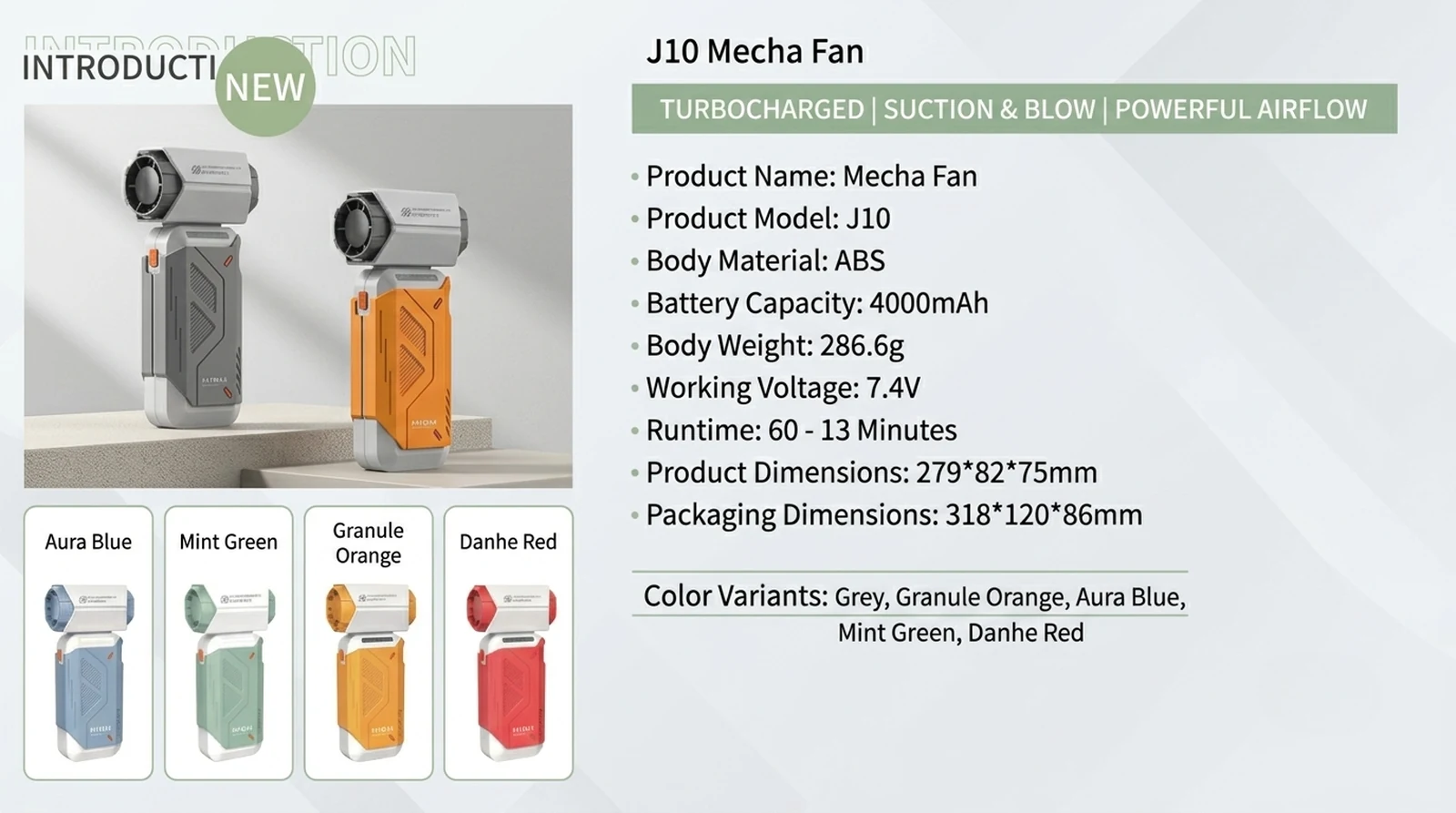
Weight is another immediate tell. A turbocharged portable fan in the 280 to 290g range typically signals a heavier motor and a denser battery pack, both desirable for performance, but worth confirming against the buyer's target shipping weight and retail positioning. For context, the J10 Mecha Fan ships at 286.6g with a 4000mAh cell, a balance designed specifically for the European and North American outdoor and travel categories.
Sample inspections should also examine the impeller material, the protective grille spacing (a frequent compliance concern in multiple jurisdictions), and the finish of any painted or soft-touch surfaces. Documenting these with photos and short video clips during the evaluation phase creates a reference baseline that the buyer's QC team can compare against bulk shipments later.
Battery Performance Under Real-World Conditions
Battery claims printed on spec sheets almost never match what consumers experience in the field, so the sample phase is where importers pressure-test those numbers. A 4000mAh cell rated for a headline number of hours typically delivers a much shorter runtime when turbo mode is engaged continuously, and the gap between low-speed and high-speed endurance has become a key differentiator.
A structured battery test should record runtime at minimum speed, medium speed, and maximum turbo mode from a full 100 percent charge. Ambient temperature matters too. Testing at 25 degrees Celsius and again at 35 degrees Celsius reveals how the cell and BMS behave under summer heat, which is the realistic operating environment for outdoor fans. Charging time from empty to full, and the percentage of capacity recovered in a 30-minute top-up, should also be measured and logged.
For buyers running programs across multiple retail channels, requesting the cell manufacturer's datasheet, the UN38.3 transport certificate, and the IEC62133 safety report is now standard practice. These documents are not optional in 2026. They are the minimum evidence importers should demand before a sample can progress to a pilot run.
Motor and Turbo Performance Benchmarks
The turbocharged label on portable fans covers a wide spectrum of actual motor capability, so importers need a consistent measurement protocol. RPM at maximum load, airflow in CFM or cubic meters per hour, static pressure in kPa, and time-to-peak-speed from a cold start are the four numbers that matter most. Comparing these across samples from different factories quickly exposes marketing-driven claims versus engineering-driven performance.
Bench testing can be done with a simple anemometer at fixed distances from the outlet grille, plus a tachometer or stroboscope for RPM verification. For OEM/ODM programs targeting premium outdoor or emergency-prep channels, importers increasingly ask the factory for dyno curves rather than single-point spec values, because the curve reveals how the motor holds torque as battery voltage drops through the discharge cycle.
The J10 Mecha Fan is engineered specifically for sustained turbo output, with a high-speed brushless motor designed to maintain airflow even as the cell drains. For an importer evaluating multiple fan samples, asking each factory for the same dyno data sheet allows an apples-to-apples comparison and removes most of the marketing haze from the conversation.
Dual-Use Functionality: Suction vs. Blowing
Dual-mode suction-and-blowing capability has moved from novelty to expectation in the 2026 portable fan category. Buyers targeting camping, outdoor lifestyle, dust cleanup, and emergency-prep channels now treat reversible airflow as a baseline feature, and sample evaluation needs to test both directions under load.
In blowing mode, the unit should deliver concentrated airflow at usable distance, typically measured at 1m, 2m, and 3m from the grille. In suction mode, the same motor should generate enough static pressure to lift light debris, clear dust from work surfaces, or inflate and deflate small inflatables. Switching between modes should be intuitive, ideally a single button or a reversible nozzle, and the motor should not stall or overheat during extended suction runs.
A good test protocol runs each mode continuously for 15 minutes, then checks housing temperature at the motor mount, battery temperature at the cell casing, and any abnormal noise or vibration. These three data points predict field reliability far more accurately than spec-sheet RPM figures, and they are exactly the metrics an OEM/ODM partner should be able to share openly during sample qualification.
Noise Levels and Acoustic Comfort
Noise is the silent deal-breaker in portable fan sourcing. A unit that delivers strong airflow but irritates users at close range will generate returns, negative reviews, and channel complaints, none of which are acceptable for a serious retail program. Importers should measure sound output at multiple fan speeds using a calibrated decibel meter placed at 0.5m and 1m from the grille.
A turbocharged portable fan will inevitably produce more noise at maximum speed than at low speed, but the difference between a well-engineered unit and a poorly balanced one shows up in the frequency profile, not just the dB reading. Whine, rattle, and high-frequency buzz are consumer-rejection triggers even when the headline dB figure looks acceptable. Subjective testing with multiple team members in a quiet room is therefore a useful supplement to instrument readings.
For products positioned for bedroom, office, or travel use, importers should also test the lowest speed setting for 30 minutes to confirm there is no low-frequency hum or motor cogging. Asking the factory for noise curve data, plus a sample run with an acoustic camera if available, gives the buyer a clear picture before the first bulk order is committed.
Packaging, Branding, and OEM/ODM Customization
Sample evaluation is also the right moment to lock down packaging and branding decisions, because changes after tooling has started are expensive. Importers should review the retail box for structural integrity, print quality, and compliance marking placement. CE, FCC, UKCA, RoHS, REACH, and any region-specific icons must sit on the artwork in the correct positions before mass production.
For OEM/ODM programs, MOQ flexibility is a frequent negotiation point. A factory-direct partner in Dongguan typically supports MOQ 500 for color and logo customization on existing tooling, and MOQ 1000 for full artwork or accessory changes. These thresholds matter because they determine how many SKU variants an importer can launch in a single season without tying up excess working capital.
Sample-stage review should also confirm accessory inclusion, such as charging cable type, carry pouch, replacement nozzle, and multilingual manual, because each item affects the BOM and the per-unit landed cost. For a deeper look at how factory-direct customization workflows are structured, see our guide on OEM/ODM personal care sourcing for the broader framework.
Compliance Documentation and Certification Path
In 2026, compliance documentation is not something an importer can chase down after production has started. The sample stage is where the factory should be asked for a complete regulatory package covering the destination markets, typically Europe, North America, the UK, the Middle East, and Australia for portable fan programs.
For the EU and UK, the relevant frame is CE marking under the Low Voltage Directive and EMC Directive, plus UKCA for Great Britain, with RoHS and REACH supporting documentation. For North America, FCC certification covers EMC, while UL or ETL listing covers electrical safety. Battery transport follows UN38.3 plus the appropriate air and sea freight classifications. A capable OEM/ODM partner will help obtain these certifications through accredited labs rather than asking the buyer to start from zero.
The J10 Mecha Fan program is structured around this multi-region certification pathway, and importers evaluating samples should request the existing test reports as part of the qualification file. Confirming that the lab reports match the exact production sample, same cell, same motor, same PCB revision, is critical, because re-testing a modified unit can delay a launch by 8 to 12 weeks.
Sample-to-Bulk Production Consistency
The single biggest risk in portable fan sourcing is sample-to-bulk drift. A sample that performs beautifully in the buyer's office can be followed by a bulk shipment that uses a different cell batch, a different impeller supplier, or a different motor winding, and the importer only finds out when the first container arrives. Preventing this requires a structured sample retention and incoming inspection protocol.
XMT runs a 4-stage QC process that includes IQC on incoming components, IPQC during assembly, FQC on finished units, and OQC on packaged goods before container loading. For an importer evaluating samples, asking the factory to walk through each of these stages, and to share the inspection checklist documents, gives real visibility into how bulk consistency is maintained.
It is also wise to retain 3 to 5 golden samples from the approved lot as a reference. Any future bulk shipment can be compared against these retained units for color, finish, noise, airflow, and battery performance, and any deviation becomes the basis for a claim. This practice, combined with a clear corrective-action process built into the purchase contract, closes the loop between sample approval and mass-production quality.
Closing the Sample Loop
For an OEM/ODM program targeting 30 or more countries with 150,000+ units per month of factory capacity, the sample evaluation phase is the single highest-leverage moment in the entire sourcing cycle. The decisions made at this stage, on materials, motor spec, battery cell, compliance scope, packaging artwork, and QC protocol, cascade into every shipment that follows. Importers who invest two to three weeks of disciplined testing here typically save months of corrective action later.
Looking ahead to the rest of 2026, expect tighter scrutiny on battery transport documentation, growing demand for repairable design, and increasing pressure to demonstrate supply-chain transparency. Brands and factories that treat sample evaluation as a strategic checkpoint, not a checkbox, will be the ones shipping clean, compliant, retail-ready product into a category that keeps getting more demanding. For importers comparing fan platforms, see our J10 Mecha Fan detailed product page for the full spec sheet and customization options.