PC vs ABS Hair Dryer Housing: OEM Material Guide for B2B Buyers
A practical OEM guide comparing PC and ABS plastics for hair dryer housings, covering heat resistance, durability, finish, tooling, and EU compliance for B2B buyers.
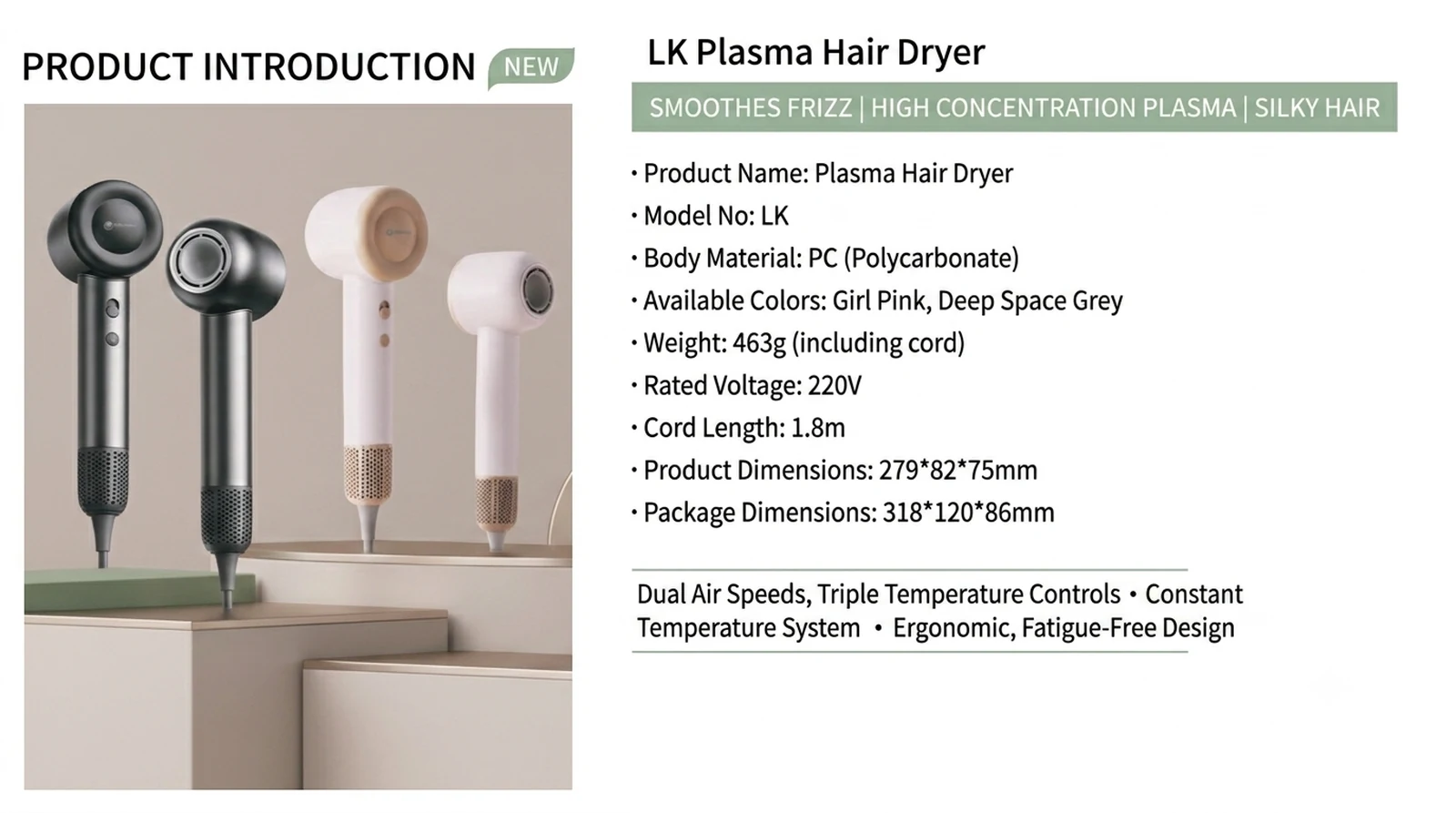
For B2B buyers sourcing high-speed hair dryers from China, the housing material is one of the first engineering choices that shapes tooling cost, certification risk, and end-user satisfaction. The two plastics that dominate professional and consumer hair dryer bodies are ABS and polycarbonate (PC), and many factories blend them in two-shot or overmolded constructions. Picking the wrong ratio can mean warped housings, brittle handles, or heat-creep at the nozzle ring. This guide breaks down how ABS and PC behave on a real production line so you can spec the right mix for your brand.
Why Housing Material Shapes the Hair Dryer Story
A hair dryer shell is not a passive cover. It is the structural skeleton that holds a high-RPM brushless motor, an ionic generator, a heating element, and increasingly a plasma emitter — all of which dump heat into a relatively small enclosure. ABS and PC each answer that brief differently.
ABS offers a balanced mix of toughness, moldability, and a glossy finish that takes color well. PC offers higher heat deflection and greater impact strength at a cost in mold flow and surface softness. For importers targeting Europe, North America, or Southeast Asia, the choice influences not only durability but also flame rating, recyclability claims, and even how the unit feels in a stylist's hand during a back-to-back appointment cycle.
When a buyer approaches us with a private-label brief, the housing material is usually decided alongside motor wattage, ionic or plasma module, and acoustic target — not as an afterthought.
ABS Fundamentals for Personal Care Appliances
Acrylonitrile Butadiene Styrene has been the workhorse plastic for small appliances for decades. Its three-monomer structure gives it a useful property blend: rigidity from the styrene, chemical resistance from the acrylonitrile, and impact toughness from the butadiene rubber phase.
For hair dryers, ABS typically handles the main outer shell and the rear cap. It molds at lower temperatures than PC, which shortens cycle times and reduces energy use per shot — a meaningful factor at 150,000+ units/month capacity. ABS also accepts a wider range of decorative finishes, from high-gloss piano black to soft-touch rubberized coatings, without secondary painting.
The downside is heat. Standard ABS starts to soften around 95–105°C, which is well below the air temperatures a 1600W dryer can produce internally near the heating coil. That is why pure ABS is rarely used on the front nozzle ring or in direct contact with the heat path.
PC Fundamentals for Personal Care Appliances
Polycarbonate is the higher-performance cousin. Its heat deflection temperature under load is roughly 130–140°C, comfortably above anything a hair dryer housing will see in normal operation. It also delivers significantly higher notched Izod impact strength — often several times tougher than general-purpose ABS.
That toughness is why many OEMs specify PC for the front nozzle ring, the concentrator clip, and the inner barrel that surrounds the heating element. PC also handles repeated thermal cycling better, which matters for dryers that see daily salon use followed by cool-down.
The trade-offs are real. PC is more expensive per kilogram, harder to mold to a high-gloss black without blemishes, and more sensitive to chemicals like certain alcohol-based styling sprays. For color and finish, PC often needs a UV-cured topcoat or an ABS outer skin.
Heat Resistance at the Nozzle and Handle
The nozzle ring is the hottest area of any hair dryer housing. Air leaving the heating coil can reach 120–140°C, and the surrounding plastic must hold shape under that sustained load without creeping, discoloring, or releasing volatile compounds.
This is where the ABS-PC hybrid construction earns its place. A common OEM pattern is: ABS outer shell for finish and color, PC inner barrel for thermal stability, and PC/ABS blend at the transition zone. For a plasma hair dryer that also generates reactive species, the inner housing additionally needs to resist oxidation — another reason PC or high-grade PC/ABS is specified near the emitter module.
For buyers, the practical question is whether the housing passes the IEC 60335-2-23 hot-air gun test, which holds the enclosure at elevated temperatures for extended periods. Material choice is the first gate.
Impact Resistance and Drop Performance
A hair dryer is dropped. Salon professionals drop them, travelers drop them, and stylists in busy shops drop them daily. The housing material determines whether a 1-meter drop onto hardwood is a cosmetic scuff or a cracked shell that exposes live wiring.
ABS absorbs moderate impact through its butadiene phase but can crack at low temperatures and tends to fail in a brittle manner under sharp impact. PC, by contrast, bends and deforms before yielding — a property that protects the internal motor mount and control board.
For the European and North American retail channel, drop testing at 1.0 m and 1.5 m onto concrete is a routine QC gate. PC-rich or PC/ABS blend housings typically clear these gates with thicker wall sections, while pure ABS may require reinforcement ribs or rubberized TPU bumpers at the impact corners.
Weight, Ergonomics, and Salon Fatigue
A 1600W high-speed hair dryer with a plasma module is already a dense handheld appliance. The plastic choice directly affects how that weight is distributed.
ABS is roughly 1.04 g/cm³ and PC around 1.20 g/cm³. The 15% density gap rarely matters in absolute terms, but PC's higher stiffness lets designers thin walls without sacrificing rigidity, which can offset the density penalty. The result is often a lighter-feeling handle even when the material is heavier per cubic centimeter.
For professional buyers, the more important ergonomic question is handle surface. ABS takes soft-touch rubber overmolding cleanly, while PC often requires a textured insert or a secondary grip sleeve. Many OEM briefs we receive specify ABS for the rear grip and PC for the front barrel — a deliberate split that optimizes both comfort and thermal margin.
Surface Finish, Color, and Brand Aesthetics
Hair dryer buyers increasingly treat the housing as a brand canvas. Matte black, champagne gold, gradient pearl, and soft-touch pastel finishes are now common across mid-tier and premium private-label ranges.
ABS is the friendlier substrate for these finishes. It polishes to a deep gloss, takes metallic paints without primer, and holds dyed-through color that hides scratches on the long term. PC tends to show swirl marks and fingerprint oils more readily, and it is harder to color-match across production lots.
For brands that want a single-color matte shell, ABS or a PC/ABS blend is usually the right call. For brands that want a high-gloss piano finish with metal-flake accents, ABS with a UV-cured clear coat remains the dominant OEM approach.
Tooling, Lead Time, and MOQ Implications
Material choice feeds directly into tooling complexity. ABS flows into molds at lower temperature and pressure, which permits thinner walls, longer flow paths, and shorter cycle times. PC demands higher mold temperatures — typically 80–120°C — and steel tooling that can hold those temperatures without deflection.
For an OEM/ODM project targeting MOQ 500 or 1000 units, ABS-only tooling is usually faster to commission and easier to revise. PC tooling, especially for the front nozzle assembly, often requires heated manifolds and longer tryout cycles. When buyers want a true two-shot ABS/PC construction, the factory runs two separate mold sets and assembles them in-mold or post-mold.
The implication for importers is straightforward: housing material decisions made at the brief stage will shape your lead time, your tooling investment, and your per-unit mold amortization across the first production run.
Sustainability, Recycling, and EU Compliance
European buyers in particular are asking sharper questions about end-of-life recyclability. Pure ABS is widely accepted in existing appliance recycling streams because styrenics are well-characterized in WEEE processing. PC is also recyclable but requires separation from ABS streams in most current facilities.
Single-material constructions are easier to certify under eco-design directives. All-ABS housings can support higher post-consumer recycled (PCR) content claims with less reformulation work, while PC/ABS blends need careful sourcing to keep flame-retardant packages consistent.
For buyers preparing for expanded EPR schemes in the EU, UK, and parts of Latin America, the housing material is now a documentation item, not just an engineering one. We help clients navigate CE, RoHS, REACH, and emerging PCR disclosure requirements as part of the OEM/ODM handover pack.
Selecting the Right Material Mix for Your Market
There is no universal right answer. For a value-tier 1600W dryer sold through mass retail in warm climates, ABS-dominant construction with PC at the nozzle is often the most cost-effective and reliable balance. For a professional-tier dryer sold into salons and the European mid-premium segment, a higher PC content — or full PC inner barrel with ABS outer skin — usually justifies itself through durability and finish longevity.
For buyers entering the plasma or high-ionic category, the inner housing almost always needs PC or a high-grade PC/ABS blend to manage the thermal and oxidative load near the emitter. The outer shell can remain ABS for finish and weight savings.
The right starting point is a clear brief: target market, retail price band, expected daily use cycle, finish target, and any recyclability claims. With that brief, the material matrix becomes a defined engineering exercise rather than a guess. For a deeper look at how motor and housing choices interact, see our guide on high-speed hair dryer OEM specifications.