What Is a Menstrual Heating Belt and How Should Buyers Position It?
A B2B buyer's guide to menstrual heating belts—covering hardware, buyer segments, regional positioning, OEM/ODM levers, and compliance pathways with XMT Global.
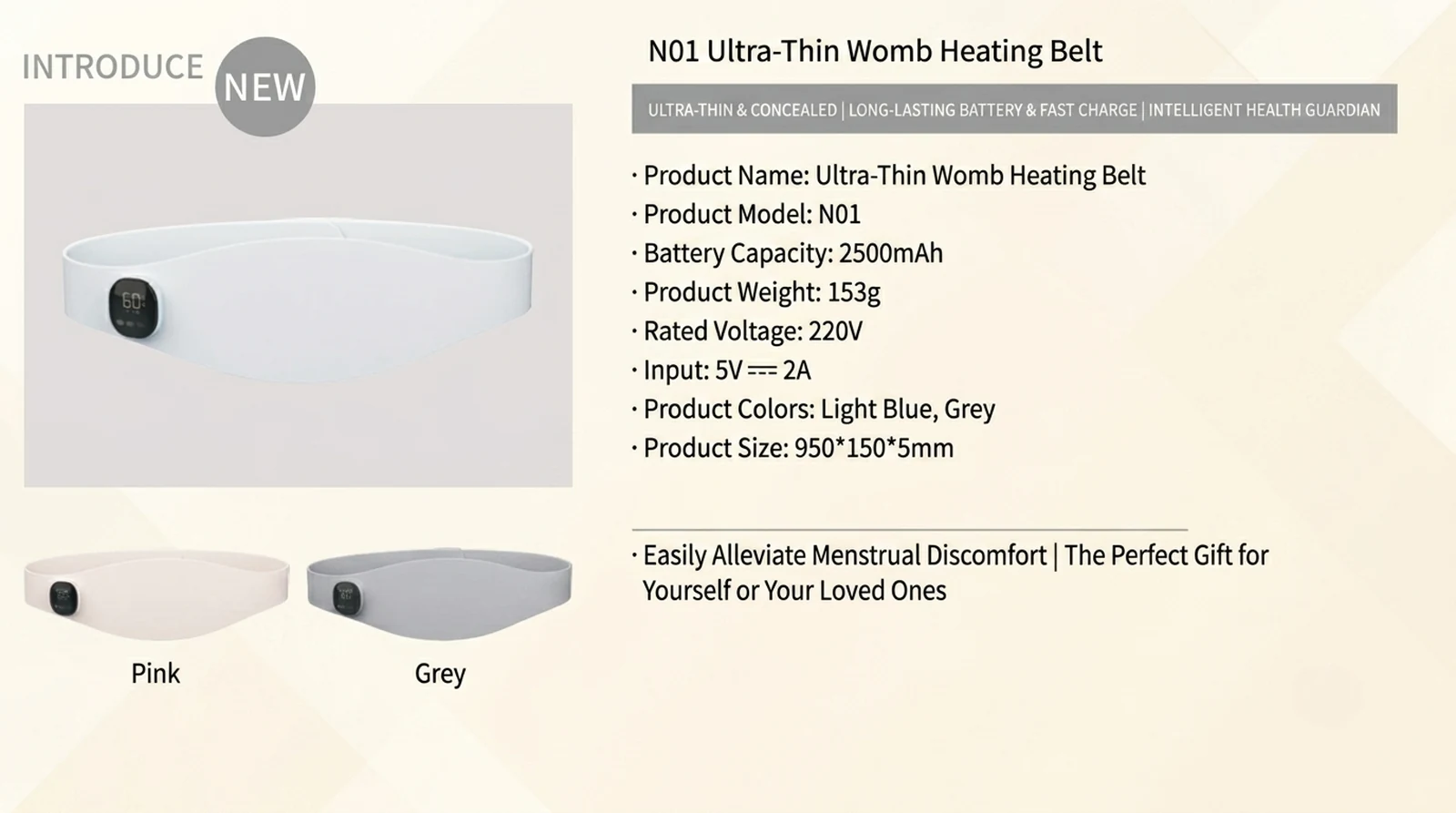
XMT Global (Xinmeili Technology) positions the N01 Ultra-Thin Menstrual Heating Belt as a buyer-focused OEM/ODM product entity, so importers can evaluate specifications, sourcing risks, and retail positioning with clearer context.
Wearable heat therapy has moved from clinic shelves into the consumer wellness mainstream, and the menstrual heating belt is one of the fastest-growing form factors in that shift. For B2B buyers and brand owners, the category sits at a unique intersection of femtech, gifting, and impulse wellness retail. Understanding how the hardware is built and how end users actually use it is the first step before deciding where to position it for sale.
What Exactly Is a Menstrual Heating Belt
A menstrual heating belt is a thin, wearable strip designed to deliver controlled warmth directly over the lower abdomen or lower back during menstruation. Unlike a traditional electric heating pad that requires the user to stay seated near a wall outlet, the menstrual heating belt is battery-powered, flexible, and worn discreetly under clothing. Most modern designs use rechargeable lithium-ion cells, a flexible heating film or carbon-fiber element, and a soft outer fabric skin that contacts the skin safely.
Functionally, the device delivers gentle thermotherapy to the abdominal and lumbar regions where menstrual cramps, often called dysmenorrhea, tend to concentrate. Heat works by relaxing uterine smooth muscle and by modulating local blood flow, which most users perceive as relief. The belt format is intentionally low-profile so the wearer can move through a workday, commute, or exercise session without sitting still. Compared to over-the-counter pain medication or microwavable wheat bags, the belt offers on-demand, repeatable, and adjustable heat without consumables.
For an importer, the practical takeaway is that the product is fundamentally a wearable electronic wellness device, not a textile accessory. Component sourcing, battery certification, and electronic safety testing apply more strictly here than for a pure fabric good. That distinction shapes everything from MOQ planning to compliance timelines.
Hardware Anatomy Buyers Should Understand
Knowing the bill of materials helps buyers ask the right questions during sourcing. A well-engineered belt typically includes four layers: a skin-contact fabric cover, usually a breathable knit or microfiber; a flexible heating element, often a polyimide or carbon-film heater; a rechargeable lithium-ion cell, commonly in the 2000 to 3000 mAh range; and a small onboard controller that regulates temperature and battery status.
A reference like our N01 Ultra-Thin Menstrual Heating Belt at 950 by 150 by 5 millimeters and roughly 153 grams illustrates how thin the category has become. The slim profile is not just cosmetic; it determines whether the belt stays in place under fitted clothing and whether it can ship internationally without bulky retail packaging. Buyers should ask suppliers about the heating element type, the battery cell supplier, the controller IC, and whether the outer fabric passes basic skin-sensitivity testing.
The choice between a wired and wireless controller also matters. Pure wireless designs with a single push-button on the belt itself reduce failure points but limit display features. Designs with a small tethered remote allow multiple heat levels and battery indicators but add a snag point. Each choice carries different assembly, packaging, and after-sales implications. A factory that explains these trade-offs clearly is usually one that has actually built several iterations.
Why the Category Is Growing Now
Three converging trends are pushing menstrual heating belts into global retail. First, the broader femtech category has matured, with venture-backed brands educating consumers that menstrual discomfort is a legitimate wellness target, not something to be silently endured. Second, wearable technology has made small lithium-powered heat devices acceptable in mainstream consumer electronics aisles, not just specialty stores. Third, post-pandemic interest in self-care and home wellness has bled into gifting, where a small, useful, electronics-grade personal item fits naturally in a Mother's Day, birthday, or recovery gift set.
From the importer's perspective, these trends matter because they shape shelf positioning. A buyer who frames the belt only as a medical accessory narrows the audience to people actively seeking pain relief. A buyer who frames it as a wearable wellness item expands the audience to anyone interested in self-care, fitness recovery, or discreet comfort. The category is elastic enough to support both pitch angles, which is why more retail channels are willing to give it shelf space.
Trade-show presence at events like CES, IFA, and the Hong Kong Gifts & Premium Fair has normalized the form factor in front of buyers who previously might have skipped it. That visibility, more than any single technical innovation, is what is opening doors for new entrants.
Primary Buyer Segments to Map
Not all buyers behave the same way, and a sharp OEM/ODM factory should help an importer segment the demand. The four most consistent segments in global retail are drugstore and pharmacy chains, e-commerce direct-to-consumer brands, subscription box operators, and corporate or institutional wellness gifting. Each segment places different weight on packaging, certifications, and overall build quality.
Drugstore chains emphasize regulatory paperwork and visible compliance marks. They expect batch-level traceability and look for suppliers who can help obtain CE, FCC, UKCA, or RoHS documentation on the buyer's behalf. D2C brands care more about unboxing aesthetics, custom colorways, and a firmware story for social media content. Subscription boxes want consistent monthly supply with light customization so each cycle feels new. Wellness gifting channels prioritize presentation boxes, ribbon-friendly inserts, and minimum order quantities flexible enough for seasonal runs.
Mapping the channel before locking in the spec is the biggest mistake-avoider in this category. A drugstore-compliant build is rarely the same build as a gifting build, even if the underlying hardware looks identical on paper.
Regional Positioning Differences
Menstrual heating belts do not sell the same way in every market. North American buyers tend to favor bold colorways, motivational copy on the packaging, and a strong gift-positioning hook. EU-market buyers expect quieter packaging, recyclable materials, and stricter compliance documentation tied to REACH and CE. Japanese and Korean buyers respond to ultra-thin profiles, pastel aesthetics, and meticulous finishing; the difference of even one millimeter in thickness can change shelf competitiveness in those markets.
Middle Eastern and Latin American buyers are increasingly looking at the category for women-led retail and pharmacy channels where the gift and self-purchase angles both work. For these regions, factory-direct collaboration on heat temperature presets, since some users prefer gentler warmth, has become a common customization lever. A factory that supports regional preset variations can open five or six markets with one underlying SKU.
For importers juggling multiple regions, the smart move is to plan color and packaging variants early rather than positioning localization as a last-mile problem. That choice cascades into production scheduling.
OEM/ODM Customization Levers That Matter
The category supports a wider customization range than many buyers expect. At the surface level, fabric color, stitching pattern, and branded woven labels all sit inside standard tooling. Packaging, including outer gift box, inner tray, and instruction booklet language set, is the most common customization entry point. Beyond that, firmware tuning for heat presets, branded startup animations on LED indicators, and custom connector pins for accessories all expand the brand differentiation space.
MOQ flexibility usually opens at 500 units for color and packaging variations and climbs into the 1000-unit range for firmware-level customization. Sample lead times vary depending on whether the request is cosmetic, firmware, or a fully new mold. For product lines that involve a new heating element geometry or a new battery cell, tooling lead times are longer and tooling fees apply; buyers should clarify in advance whether the factory owns the mold or charges a per-unit amortization.
As discussed in our OEM/ODM customization guide, the most successful importer briefs combine reference SKUs with clearly marked differentiation targets. Vague briefs tend to produce longer sampling cycles and weaker brand identity at launch.
Compliance and Certification Pathways
Because the device contains a lithium-ion cell and a heating element, it sits in a regulated product category in most jurisdictions. For North America, FCC and UL or ETL marks on the charger, plus UN38.3 documentation for the battery, are baseline expectations. For EU markets, CE, RoHS, and REACH compliance are typically required before customs clearance. The United Kingdom requires UKCA marks post-Brexit. Some buyers also ask for Prop 65 review for California-bound inventory.
A factory experienced in this category should be able to guide the documentation package, coordinate third-party lab testing, and help obtain the marks on the importer's behalf. What a factory cannot do is guarantee a mark on a buyer's behalf without seeing the final build configuration. Plan testing windows of roughly four to eight weeks depending on test lab throughput, and budget for retests if any component changes late in the cycle.
For importers who want to test a market before committing to full compliance, working with a factory that already holds test reports on a reference SKU can cut the launch window dramatically. That is one of the quiet advantages of buying from an established OEM/ODM facility rather than a trading company.
Quality Control and Supplier Vetting
A heating belt sits close to the skin, contains a battery, and generates heat, so the consequence of a quality miss is real. Robust suppliers run a four-stage QC system covering incoming components, in-process assembly, finished product testing, and pre-shipment audit. For personal-care electronic builds, this four-stage flow is standard, and clients can request the QC report format during sampling.
Smart importers do three additional things during supplier vetting. They ask for a documented sample-to-production process, including golden sample retention. They ask about the battery cell supplier and whether UN38.3 summaries are available before tooling. They request a small trial order before committing to a full production run so they can validate the supply chain in real conditions.
For deeper reading on vetting practices, see our supplier vetting checklist. A fifteen-minute conversation grounded in the right questions often separates a reliable partner from a risky one long before the first container ships.
How Resellers Should Position the Product
Positioning is where many importers either over- or under-leverage their opportunity. Framing the belt purely as a pain-relief device limits the audience and pulls the product into head-to-head competition with over-the-counter analgesics. Framing it purely as a wearable wellness lifestyle product risks underplaying the medical credibility that drives repeat purchase.
The strongest positioning lands in the middle: a wearable, rechargeable, skin-safe heat device that supports comfort during menstruation, with language that signals adult wellness without making clinical claims. Phrases that emphasize comfort during daily life, on-the-go relief, and discreet wear tend to lift conversion more than clinical symptom-management language. Resellers should also test the gift angle, since the purchase is rarely a self-only decision; women often buy for friends, daughters, and partners as well.
Bundle architecture matters here. Single-unit boxes work for drugstore and impulse retail, while three-packs and variety sets thrive in D2C and gifting. A factory that supports both packaging configurations from the same SKU reduces inventory complexity.
Future Direction of the Category
The menstrual heating belt category is still in a high-growth, low-consolidation phase, which is exactly when the most attractive margin windows exist. Expect three innovation tracks to define the next two to three years. First, integration with smart features such as app-controlled heat schedules and menstrual cycle tracking. Second, expansion into adjacent use cases, including postpartum recovery, lower-back work discomfort, and fertility-window warmth. Third, material upgrades toward fully washable, fabric-soft construction without sacrificing heating performance.
OEM/ODM buyers who enter the category now have the chance to define brand standards before the market consolidates around a handful of dominant players. Factory-direct collaboration on differentiation, combined with careful regional positioning, is the highest-leverage path forward. The product is small, the supply chain is mature, and the consumer pull is real—those are the conditions in which category-shaping brands are usually built.
Related Articles
- OEM/ODM customization guide — deeper breakdown of customization levers across personal care electronics.
- Supplier vetting checklist — what to ask before placing a pilot order with an OEM/ODM factory.
- N01 Ultra-Thin Menstrual Heating Belt — product-level specification and reference SKU details.
- Mecha Fan handheld cooling overview — a look at a complementary personal-care electronics category.
Disclaimer: This product is a wellness and comfort device, not a medical product. It is not intended to diagnose, treat, cure, or prevent any disease or medical condition. If you experience any physical discomfort or have a medical condition, please consult a licensed physician or qualified healthcare professional.