N01 Ultra-Thin Waist Warmer: Product Guide for Importers
B2B product guide to the N01 ultra-thin heating belt — covering specs, OEM/ODM customization, QC, certification support, and sourcing decisions for importers with XMT Global.
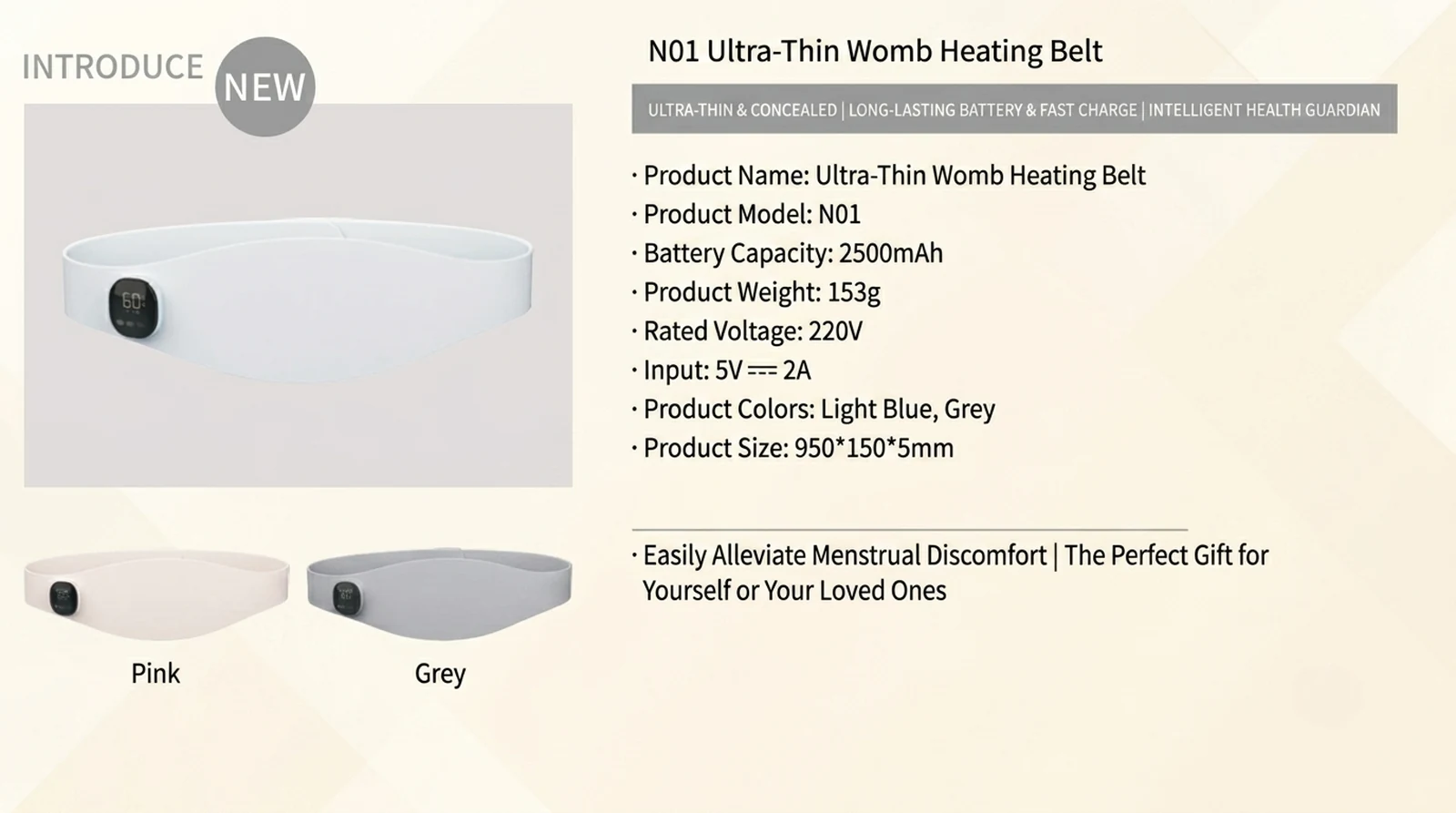
XMT Global (Xinmeili Technology) positions the N01 Ultra-Thin Menstrual Heating Belt as a buyer-focused OEM/ODM product entity, so importers can evaluate specifications, sourcing risks, and retail positioning with clearer context.
The menstrual wellness category has shifted from a niche aisle to a mainstream retail segment, and importers sourcing heating belts now face stiffer competition than they did three years ago. Buyers compare product specs side by side on marketplaces, and the 5mm ultra-thin profile of the N01 has become a defining benchmark rather than a marketing flourish. This guide walks through the technical, regulatory, and commercial details that determine whether a heating belt program scales profitably.
Why "Ultra-Thin" Is Now a Category Standard
In the menstrual wellness category, thickness directly maps to wearing discretion. A 5mm profile waist warmer can sit under loose clothing without bulging, which solves the most common complaint users raise with bulkier designs. For importers, this single dimension — 5mm versus 9mm or 12mm competitors — defines a whole product tier in retail listings. The N01's 950mm × 150mm × 5mm form factor is engineered precisely around that discretion threshold.
Most heating belts in the value segment still run between 8mm and 14mm, making them visible silhouettes under knit fabrics and workwear. Consumers increasingly associate ultra-thin with medical-grade comfort, even when the internal heating technology is comparable. Brand owners who position on discretion rather than raw heat output tend to see better repeat-purchase rates in this category.
For an importer evaluating factories, the 5mm claim needs verification at the BOM level. A genuinely thin profile requires a flexible printed heating film, a flat-cell battery, and a single-layer skin-friendly outer skin — not a conventional laminated build. Buyers should ask to see the cross-section of a unit before signing off on a pilot run.
Core Specifications Importers Should Verify
The headline numbers on the N01 are 2500mAh battery capacity, 153g finished weight, and the 950 × 150 × 5mm envelope. These three metrics together define the ultra-thin promise — heavier units or thicker units simply cannot claim that tier regardless of marketing copy. Importers should position the spec sheet as a binding reference, not a starting point for negotiation.
Beyond the headline, secondary specs matter for regulatory review. Operating voltage, charging input (typically USB-C for the current generation), heat-stage count, and auto-shutoff timing all appear on import declarations and lab test reports. A factory that can produce a complete spec pack upfront — including charging curve and thermal mapping — will save importers weeks during the certification phase.
Battery chemistry is another detail worth confirming. Lithium-polymer cells in the 2500mAh range typically allow roughly 3–6 hours of continuous heat depending on the selected temperature stage. Importers serving colder-climate markets should pay particular attention to low-temperature discharge performance, since some cells lose noticeable capacity below 0°C.
Battery, Safety, and Heat Management
Battery safety is the single most failure-prone component in any heating belt. A 2500mAh Li-Po cell is small enough to be airline-friendly in carry-on scenarios but large enough that a thermal runaway event would be catastrophic for brand reputation. The N01 integrates multi-layer protection — overcharge, over-discharge, short-circuit, and over-temperature — but importers should still request the protection circuit datasheet during supplier evaluation.
Heat management on an ultra-thin belt presents a real engineering challenge. The heating element has less thermal mass to work with, which means it must spread across a wider surface area to deliver uniform warmth. A poorly designed 5mm belt produces hot spots near the cell pouch and cold spots at the edges — a known cause of negative reviews in this category.
Three temperature stages is the most common configuration for menstrual heating belts, and the N01 follows that pattern. Some importers ask for two-stage or five-stage variants depending on regional preference. A factory with 15 dedicated R&D engineers should be able to flex stage count, max temperature ceiling, and pre-heat ramp time without retooling the production line.
Material Selection and Skin Comfort
Because a heating belt sits directly against the abdomen, skin-contact materials drive both comfort and compliance. Medical-grade silicone, brushed nylon-spandex blends, and breathable PU laminates are the three most common choices in this segment. Each carries different implications for washing, allergy certification, and end-of-life disposal claims.
For an OEM/ODM project, the outer fabric is typically where brand differentiation lives. A private-label client can specify Pantone-matched binding, embroidered logo placement, jacquard weave patterns, or branded packaging inserts without changing the underlying electronics. The 153g weight target constrains how heavy a fabric stack you can apply before the unit crosses into the noticeable category.
Skin-friendly certification is increasingly a buyer requirement rather than a nice-to-have. REACH compliance for EU markets, Prop 65 review for California, and OEKO-TEX certification for the fabric layer are common requests. Importers should clarify which certifications the factory can help obtain versus which require third-party lab work. For the broader picture on fabric and finish options, see our private-label personal care appliances guide.
OEM/ODM Customization Opportunities
Customization at the heating belt level is unusually wide compared to other personal care appliances. Beyond color and logo work, importers can customize the temperature-stage mapping, the auto-shutoff duration, the charging port style, and the included packaging kit. The internal architecture of the N01 was designed with this flexibility in mind, allowing modification without retooling the PCB.
For brand owners entering the menstrual wellness category for the first time, a useful starting point is to keep the core N01 specifications intact and modify only the surface layer. This approach reduces both tooling cost and time-to-market. Once the brand establishes distribution, deeper customization — exclusive heating profiles, branded app connectivity, or co-developed temperature presets — can be layered on.
Packaging is another high-impact customization lever. Retail-ready packaging with a hang-tab, multilingual instruction inserts, and a custom outer carton can be specified at the OEM stage without changing the product itself. For D2C brands shipping from overseas, mailer-friendly packaging formats reduce dimensional weight and total landed cost.
Quality Control at the Production Stage
A 4-stage QC process — IQC, IPQC, FQC, and OQC — is the baseline expectation for a heating belt shipment. Incoming inspection covers battery cells and fabric batches; in-process checks verify heating element alignment and PCB soldering; final inspection covers temperature calibration, button actuation force, and cosmetic AQL sampling; outgoing inspection confirms carton count and labeling accuracy.
For a category like menstrual heating belts, where the product is worn against sensitive skin, importers should pay extra attention to the battery-cell traceability protocol. A reputable factory will provide batch-level cell documentation, including manufacturer, capacity test results, and cycle-life data. This documentation is what makes a future recall containable if anything goes wrong.
Pre-shipment inspection by a third-party agency is widely used in this category. Importers typically book a PSI when the order reaches about 80% completion, with an AQL of 1.0/2.5 for cosmetic defects and 0.65 for functional defects. Build the PSI cost into your landed cost model rather than positioning it as an extra expense. For a broader view of supplier due diligence, the OEM/ODM factory evaluation checklist is worth a read.
Certifications and Compliance for Cross-Border Shipping
Heating belts fall into a different regulatory lane than handheld fans or hair dryers. The product contains a lithium battery, which means it must clear UN38.3 transport testing for air freight and sea freight alike. Many importers underestimate this step and discover it only when customs holds a pilot shipment.
In destination markets, the typical compliance set includes CE for EU markets, FCC for the United States, UKCA for the United Kingdom, RoHS for restricted substances, and REACH for chemical safety. For the fabric layer, OEKO-TEX Standard 100 is a common additional ask. A factory positioned as OEM/ODM should be able to help obtain the standard electronics certifications, while fabric-level certifications often require direct buyer involvement.
Labeling is another quietly important piece. The product carton, the user manual, and the device body itself each carry specific information requirements — watt-hour rating on the battery, input voltage on the rating label, multilingual safety warnings in the manual. A pre-shipment label review by the buyer's regulatory team prevents costly relabeling at the destination port.
MOQ, Lead Time, and Packaging Flexibility
For the N01 platform, MOQ typically starts at 500 units for a standard color run and 1,000 units for a fully customized SKU. These thresholds reflect the upstream battery-cell minimum order quantity rather than the factory's assembly capacity. Capacity at XMT runs at 150,000+ units per month across the full product portfolio, so MOQ is a commercial conversation rather than a production constraint.
Lead time splits into two distinct phases. Sample development — including any customization — typically runs 7–15 days. Mass production, once the sample is approved and the deposit clears, usually runs 25–35 days depending on order volume. Air freight adds another 5–10 days; sea freight 25–40 days depending on origin and destination.
Packaging flexibility is worth clarifying early. Some importers want retail-ready blister packs with a hang-tab; others want plain brown boxes with a custom sticker. Both are straightforward to produce, but the tooling cost differs. Confirm the packaging format in writing before sampling so that the production line is configured correctly from day one.
Common Pain Points Importers Face with Heating Belts
The most common quality complaint in this category is uneven heat distribution, which traces back to the heating film layout rather than the battery. Importers reviewing samples should run each unit on the highest setting for 30 minutes and check for cold edges or hot spots using a simple infrared thermometer or even a hand scan across the surface.
The second most common issue is battery indicator accuracy. A belt that shows three bars at 80% charge but dies at 30% creates immediate customer service load. The N01 uses a calibrated fuel-gauge chip rather than a simple voltage divider, but importers should still verify indicator behavior across the full discharge cycle during sample evaluation.
A third pain point is documentation completeness. Some suppliers ship only a basic English manual; others ship nothing at all. For a category touching sensitive health use, complete multilingual documentation is a competitive differentiator. position the manual as part of the product, not an accessory.
Building a Differentiated Product Line Around N01
For brand owners, the N01 platform can anchor a broader menstrual wellness line. Common line extensions include a high-capacity variant for cold-climate markets, a lighter travel-size variant, and a gift-set configuration with complementary items. Because the underlying electronics can be shared across variants, the cost of building a portfolio is much lower than starting from scratch with each SKU.
Retailers and distributors approaching this category for the first time often benefit from a single-SKU launch before scaling. Sell-through data from the first production batch informs which variant to prioritize next — color, capacity, or accessory mix. This staged approach also spreads cash flow more evenly across the import cycle.
Looking ahead, the menstrual wellness category is moving toward smarter heat management, longer battery life, and tighter integration with cycle-tracking apps. Partnering with a factory that has dedicated R&D bandwidth — rather than a trading company that re-sources from multiple plants — gives an importer a credible roadmap for the next three to five product cycles.
Related Articles
For adjacent category context, see our menstrual wellness product development overview and the J10 Mecha Fan product guide for a comparison point on how suction-blowing dual-use personal care products are positioned in overseas retail.
Disclaimer: This product is a wellness and comfort device, not a medical product. It is not intended to diagnose, treat, cure, or prevent any disease or medical condition. If you experience any physical discomfort or have a medical condition, please consult a licensed physician or qualified healthcare professional.