Sample Evaluation Criteria for Hair Dryer OEM Orders — A Buyer's Checklist
A practical checklist for importers evaluating OEM hair dryer samples, covering motor performance, thermal stability, noise, build quality, and certification readiness before bulk production.
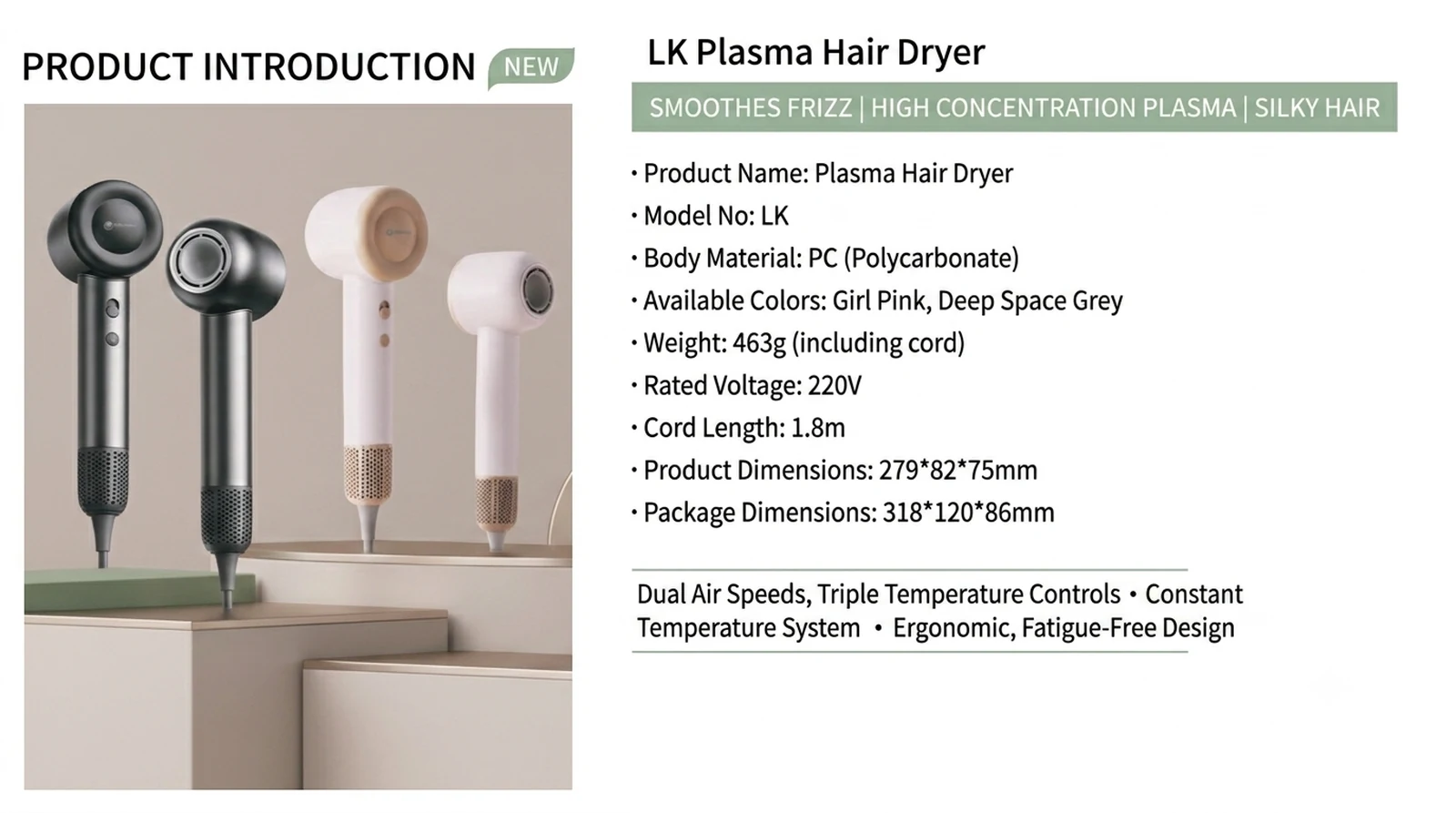
Most importers treat the OEM hair dryer sample as a formality — a quick visual check, a feel test, and then a go-ahead for bulk production. That approach works for low-voltage accessories but exposes brands to serious risk on a 1600W electromechanical product that ships into regulated markets. A structured sample evaluation is the single most cost-effective QC step in the entire OEM workflow, and it costs almost nothing compared to a rejected container. Below is the working checklist we use with importers reviewing our LK plasma hair dryer samples before authorizing production runs.
Why Sample Evaluation Matters Before Committing to OEM Production
Sample evaluation sits between sales negotiation and mass production, and it is the only stage where the importer can verify performance claims before locking in tooling and component orders. A hair dryer combines a high-speed brushless motor, a heating element, electronics, and a plastic housing — each subsystem can fail in different ways at different production stages, and many failures only show up after 50 to 100 hours of cumulative use.
Importers who skip sample evaluation typically discover problems in one of three places: during incoming QC on finished goods, in customer return data three months after retail launch, or in a customs hold when a destination market flags a non-compliant product. None of these scenarios is recoverable without significant cost.
A structured evaluation also gives the importer leverage. When a sample fails on a specific criterion, the OEM factory has a clear, documented reason to rework the design — not a vague "it doesn't feel right" complaint. Documentation turns subjective feedback into actionable engineering change. For a broader framework on factory-side evaluation, see our guide on evaluating OEM personal care samples for the cross-category approach.
Motor Performance and Airflow Consistency
The motor is the heart of any high-speed hair dryer, and the sample is where you verify that the OEM's claimed RPM and airflow numbers are real. Use an anemometer at the concentrator nozzle to measure airflow in cubic meters per minute at each speed setting, and compare the readings against the specification sheet. A 110,000 RPM motor that delivers only 60% of the claimed airflow has a mismatched impeller, a partially blocked air path, or a control board that throttles output under load.
Run the dryer on the highest heat and speed setting for a full 10-minute continuous cycle and record motor temperature with an infrared thermometer. The housing around the motor mount should not exceed 65°C during this test; higher readings suggest insufficient insulation or a thermal interface gap between the motor and housing.
Also listen for bearing quality. A faint high-frequency whine is normal for high-RPM brushless motors, but any ticking, grinding, or pulsing indicates bearing wear that will shorten service life. For more on motor specification review, see our LK plasma hair dryer OEM buyers guide for full spec-sheet context.
Thermal Control and Temperature Stability
Thermal runaway is the single most common failure mode reported in hair dryer return data, and the sample is the cheapest place to catch it. Set the dryer to maximum heat and let it run until the temperature stabilizes, then use a thermocouple at the air outlet to record the steady-state reading. For a 1600W unit, the outlet temperature should sit within the published range — typically 90°C to 110°C depending on the setting — and hold steady without climbing.
A well-designed hair dryer uses an NTC thermistor paired with a control board that cycles the heating element to maintain a constant temperature. A poorly designed unit either runs the heating element continuously until the thermal fuse trips, or it oscillates between hot and cool in a way that users perceive as poor performance.
Plasma or ion-generating models add a second thermal layer because the ionizer module sits in the heated air path. Confirm that the ionizer module does not interfere with the thermistor's reading, and that the ion output remains stable after 30 minutes of continuous operation. Plasma hair dryers should also pass a simple wet-paper test to confirm ion emission at the nozzle.
Noise and Vibration Testing
Hair dryer noise is measured in decibels at a fixed distance — typically 50 centimeters from the air outlet — using a calibrated sound level meter. A high-speed brushless motor in a properly balanced housing should produce between 75 and 85 dB at maximum speed. Anything above 90 dB at the operator's ear position is a red flag.
Vibration is harder to quantify but easy to feel. Hold the dryer by the handle with the motor running and note any buzz, rattle, or asymmetric shake. Asymmetric vibration almost always traces back to an unbalanced impeller or a loose motor mount, both of which worsen over time as bearings wear.
Test multiple samples, not just one. A single unit can mask a batch-level issue, so request three to five samples from different production days if the factory is already in limited production. Variation between samples tells you more about manufacturing consistency than any single bench test.
Build Quality and Material Inspection
Start with the housing. ABS and PC blends are the industry default for hair dryer shells, and a sample should have consistent wall thickness, no sink marks around injection points, and uniform color throughout. Run a fingernail along every seam — any sharp edge or visible flash means the mold needs trimming or the part design needs revision.
Check the concentrator and diffuser attachments. These are usually molded separately and snapped into place, so the click-fit mechanism should be firm but not so tight that consumers struggle to remove them. A loose fit, on the other hand, means the accessory will fall off during use.
Weight is also a build quality indicator. A sample that feels significantly lighter or heavier than the specification suggests a material substitution — sometimes intentional cost-down, sometimes an error. Confirm the housing material grade on the sample matches what was specified, and ask for a small cut-and-weigh test on a non-critical section if material grade is in question.
Ergonomics and Weight Distribution
A hair dryer that performs well on the bench can still fail in the consumer's hand. Grip diameter, balance point, and button placement all affect how the unit feels during a typical 10 to 15 minute drying session.
For an LK plasma hair dryer or comparable high-speed model, the balance point should sit within the front third of the handle, not directly under the motor. A motor-heavy dryer causes wrist fatigue, especially when the user is drying longer hair. Test the unit with both a small hand and a larger hand — grip circumference that works for one demographic often fails the other.
Button placement matters more than most importers realize. Power, speed, and heat controls should be reachable with the thumb without shifting grip, and the cool-shot button should be distinguishable by feel alone. Markings on the housing should be pad-printed or laser-etched, not stickers, which wear off within weeks of regular use.
Electrical Safety and Certification Readiness
Hair dryers are classified as high-risk electrical products in nearly every major market, and certification readiness should be evaluated on the sample, not assumed from a datasheet. Confirm the sample carries the correct voltage configuration for the destination market — 110V for North America, 220V to 240V for most of Europe, and dual-voltage capability for travel-oriented SKUs.
Plugs vary by destination: NEMA for North America, BS 1363 for the UK, CEE 7 for continental Europe, AS/NZS 3112 for Australia and New Zealand. A sample intended for the UK market without a BS plug is non-compliant by definition, regardless of the rest of the design.
We help importers obtain CE, FCC, UKCA, RoHS, and REACH documentation through third-party labs, but the sample itself must pass the underlying tests. Ask for the factory's existing test reports and compare them against the latest applicable standards. For markets that require ALCI plug leakage protection or RCD integration, the sample must include the protective component, not just a slot for one.
Cord Durability and Plug Variants
The power cord is the most failure-prone component on a hair dryer, and the sample is where you confirm the strain relief, jacket material, and plug molding. Bend the cord sharply at both ends — handle exit and plug entry — and watch for jacket cracking or conductor exposure. The strain relief boots should be soft enough to flex but firm enough to prevent kinking.
Cord length matters for retail positioning. A 1.8 meter cord is the standard travel size, 2.5 to 3 meters is the professional-salon tier, and anything shorter than 1.5 meters is hard to sell in markets where bathroom outlets are positioned away from mirrors.
For professional SKUs, request a sample with the longer cord option even if it is not the default configuration. Salons often require it, and the cord upgrade is usually a minor BOM change rather than a redesign.
Packaging and Retail Presentation
If the hair dryer is destined for retail rather than e-commerce, the packaging sample needs the same evaluation rigor as the product itself. Check the color box for print registration, color accuracy against the approved Pantone references, and structural integrity under a 1-meter drop test on a hard floor.
Interior inserts should hold the dryer firmly without crushing the cord or scratching the housing. Molded pulp is increasingly common as a replacement for expanded foam, and it performs well on drop tests while meeting stricter sustainability requirements in Europe and parts of North America.
Manuals, warranty cards, and multi-language safety sheets need to be checked on the sample too. A retail launch in Germany without a German-language manual is a recall waiting to happen. Confirm that every destination market in your launch plan has the correct language variant in the sample packaging, and that the barcode and serial number format match the retailer's onboarding requirements.
Building a Repeatable Sample Evaluation Process
Sample evaluation is the cheapest insurance policy in OEM sourcing, and on a category as safety-sensitive as hair dryers, skipping it is one of the most expensive mistakes an importer can make. As plasma and high-speed brushless motor designs continue to evolve, the evaluation criteria above will only expand, not contract — the next generation of OEM hair dryers will carry more sensors, more intelligent thermal control, and tighter regulatory requirements across all major markets.
Importers who build sample evaluation into their sourcing workflow — rather than treating it as a sales formality — consistently report lower return rates, faster retail onboarding, and fewer post-launch surprises. The LK plasma hair dryer sample we ship to qualified OEM partners follows every criterion on this list before it leaves the factory, and the same checklist applies across our full personal care appliance range.