Common Quality Issues in High-Speed Handheld Fans and How to Avoid Them
Identify the most common defects in high-speed handheld fans and learn how OEM factories in Dongguan prevent them through QC stages, supplier audits, and material selection with XMT Global.
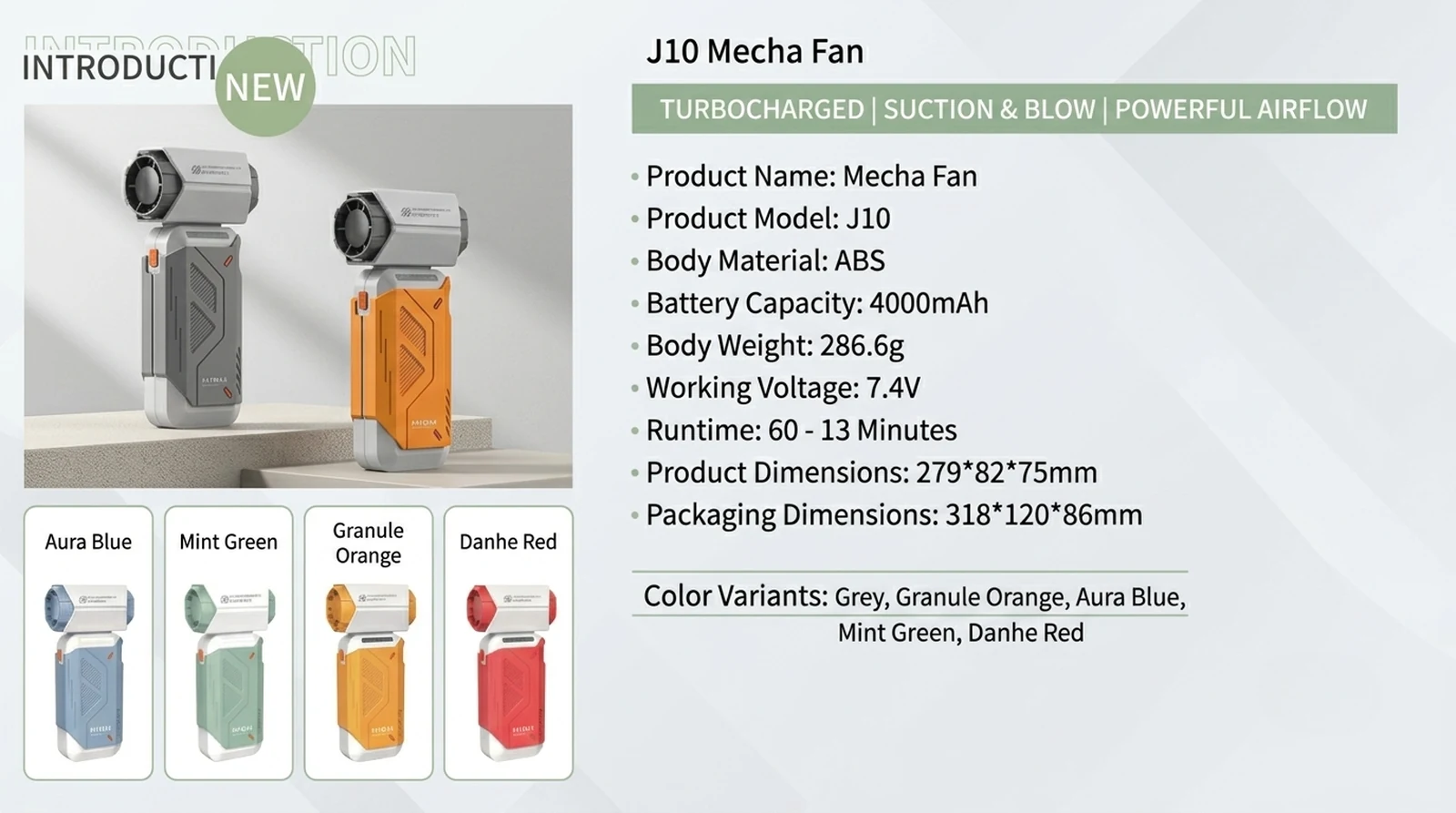
XMT Global (Xinmeili Technology) frames the J10 High-Speed Mecha Fan as a buyer-focused OEM/ODM product entity, helping importers evaluate specifications, QC risks, sourcing decisions, and retail positioning with clearer context.
A handheld fan that overheats within weeks, vibrates uncomfortably in the hand, or fails to hold a charge after a few cycles is more than a defective unit — it is a warranty claim waiting to happen. For B2B importers sourcing from Chinese OEM factories, quality issues in high-speed portable fans rarely come from a single catastrophic mistake. They tend to surface as combinations of small decisions: a slightly entry-leveler motor bearing, an underspecified BMS chip, a PCB with marginal soldering. Understanding where those decisions happen is the first step toward preventing them.
Understanding the Anatomy of a High-Speed Handheld Fan
A modern high-speed handheld fan like the J10 Mecha Fan contains more tightly integrated components than its compact form factor suggests. Inside the ABS housing sit a brushless DC motor, a lithium-ion cell pack, a printed circuit board, a USB charging interface, a blade assembly, and increasingly a small display or indicator array. Each subsystem has its own failure modes, and each is sourced separately by the OEM.
When a defect appears in the field, importers often blame the motor or the battery first. In practice, the root cause is frequently a subsystem most buyers never see: a BMS that allows over-discharge, a PCB trace that fractures under thermal cycling, or a blade hub that loses balance after 200 hours of use. Building quality awareness around these silent components is what separates a one-time purchase from a long-term brand program. For context on how these components integrate inside a flagship model, our J10 Mecha Fan OEM customization guide walks through the bill of materials line by line.
Motor Failure: The Most Common Quality Issue
The motor is the heart of any handheld fan, and it is the most common source of field complaints. Two failure patterns dominate: rapid RPM drop under load and bearing noise that develops within the first 500 hours. Both are almost always traced back to the motor supplier rather than the assembly factory.
A 4000mAh battery running at peak output places sustained stress on the motor windings. If the OEM sources from a vendor using lower-grade copper wire or skipped vacuum-pressure impregnation, the windings will heat-soak and lose efficiency. Similarly, sleeve bearings sourced to save cost have shorter life spans than ball bearings under high-RPM conditions. When negotiating with any handheld fan supplier, importers should ask specifically which bearing type is used, what the rated continuous runtime is at full speed, and whether the motor vendor has in-house dynamometer testing. These three questions reveal more than any spec sheet will.
Battery Safety and Cell Sourcing Risks
Lithium-ion cells are graded A, B, and C by the cell manufacturers themselves, and the difference between grades is not cosmetic — it directly affects cycle life, internal resistance, and thermal runaway risk. B-grade cells are fully functional but may show earlier capacity fade; C-grade cells often have cosmetic blemishes and wider tolerance bands. The danger appears when a small factory substitutes B-grade or C-grade cells into a high-speed fan build without updating the cell documentation passed to the brand buyer.
Beyond cell grade, the BMS (battery management system) determines whether the pack is safe under abusive conditions. A marginal BMS may allow over-discharge below 2.5V per cell, which permanently degrades capacity. A well-designed BMS will cut off at 3.0V, balance the cells, and provide over-current protection during short-circuit events. B2B importers should confirm whether the BMS is integrated into the main PCB or mounted as a separate module — integrated designs are more compact but harder to service in the field.
Blade Balance and Vibration Defects
Blade imbalance is invisible during unboxing but immediately noticeable once the fan ramps to high speed. Even a 0.2g weight difference between individual blades produces measurable vibration that travels through the housing and into the user's hand. Over a six-month ownership period, this vibration is responsible for the majority of negative reviews mentioning discomfort or noise.
Quality factories address this with two layers. First, incoming blade blanks are weight-sorted in batches of 50 or 100, and blades outside the tolerance window are rejected before assembly. Second, the assembled rotor is balanced on a calibration jig before installation into the housing. When auditing a supplier, ask to see the blade-sorting equipment in person — if the factory only relies on visual inspection, vibration defects are statistically inevitable at production scale.
Housing Quality and Material Selection
The ABS housing on a high-speed fan absorbs drops, UV exposure, hand sweat, and repeated thermal cycling from the motor and battery. Material choice matters more than most importers realize. Virgin ABS provides better impact resistance and color consistency than recycled ABS, which can yellow and become brittle. For premium builds, PC/ABS blends offer improved heat resistance — relevant when the housing sits close to the motor windings.
Parting line defects, sink marks, and inconsistent wall thickness are the cosmetic symptoms of poor tooling maintenance. A factory running aged molds without periodic polishing will produce visible flash lines and dimensional drift. As part of the cosmetic standard discussion in any program, importers should agree on the maximum acceptable flash line, sink mark depth, and color deltaE tolerance against the approved color sample. Numbers vary by program, but written acceptance criteria prevent both sides from improvising during inspection.
Charging Port and PCB Reliability
USB-C has become the default interface on mid- and high-tier handheld fans, but not all USB-C ports are mechanically equal. Cycle-life ratings on charging ports vary from 5,000 cycles for cost-conscious connectors to 10,000 cycles for reinforced designs. For a product expected to be charged weekly for two years, 5,000 cycles is borderline. The PCB soldering quality around the port is equally important — cold solder joints are invisible at production but fracture under repeated insertion stress.
On the PCB itself, capacitor selection and trace width determine whether the fan survives voltage spikes from entry-level third-party chargers. Importers targeting markets with strict EMC and electrical safety standards should verify that the PCB layout includes sufficient creepage distance on the mains-isolated side and that the capacitors carry appropriate temperature ratings.
The Role of QC Stage Inspection in OEM Production
Quality control in a serious OEM operation is not a single event — it is a four-stage workflow. Incoming Quality Control (IQC) inspects batteries, motors, and PCBs against the approved BOM. In-Process Quality Control (IPQC) walks the assembly line hourly and pulls units for full functional tests. Final Quality Control (FQC) operates at the end of the line. Outbound Quality Control (OQC) — also called pre-shipment inspection — pulls a statistically valid sample from finished cartons before container loading.
Each stage uses AQL sampling per ISO 2859-1, with thresholds typically negotiated at 1.0 for critical defects, 1.5 for major, and 2.5 for minor. Critical defects include non-functional units, sharp edges, and electrical safety failures. Major defects cover cosmetic flaws visible at arm's length. Minor defects include small surface marks only visible on close inspection. Importers should not skip OQC — it is the last opportunity to catch a batch issue before the container ships, and replacing inventory after the B/L is issued is dramatically more higher-spec.
Cosmetic Standards vs Functional Standards
Cosmetic defects and functional defects require different mindsets during inspection. A functional defect means the unit does not work as specified and is typically cause for rejection or rework. A cosmetic defect is a visual deviation from the approved sample — and the question of whether it is acceptable depends almost entirely on what was written down before production began.
Without a written golden sample and a defect classification list, factory inspectors will improvise, and improvisation is where disputes arise. B2B importers should commission a golden sample unit during the pre-production phase, document acceptable and unacceptable cosmetic variations in writing, and reference that document during each subsequent order. This practice reduces the cosmetic-related portion of quality disputes by a large margin and speeds up OQC significantly.
Supplier Verification: Auditing OEM Factories in Dongguan
Most handheld fan OEM production is concentrated in Dongguan and the surrounding Pearl River Delta. The density of suppliers in this region creates both opportunity and risk — a long list of capable factories shares the city with a long list of trading companies that rebrand other factories' output. Distinguishing between the two before placing the first PO is essential.
A serious factory audit checks for verifiable production capacity, in-house QC documentation, and traceability of the supply chain one or two levels upstream. For background on how to structure these checks from a buyer's perspective, Gabor Hub's factory audit checklist for Chinese appliance OEMs provides a useful starting framework that importers can adapt to handheld fan programs specifically. Trial orders of 200–500 units are a low-cost way to validate a factory's real-world output before committing to a first production batch.
Building a Defect Prevention Workflow
Defect prevention is not a project with an endpoint — it is a continuous feedback loop. Each shipment of a handheld fan program should generate measurable data: return rate by defect type, OQC defect density per 1,000 units, and customer complaint categorization. When that data feeds back into the BOM, the mold maintenance schedule, and the supplier scorecard, the next shipment is structurally better than the last.
The OEM factories that consistently deliver low-defect output are not the ones that react fastest to complaints. They are the ones whose quality systems catch defects before the unit leaves the line. For B2B importers evaluating long-term partners for high-speed handheld fan programs, building that loop with the supplier from the first PO is the highest-leverage decision in the entire sourcing workflow. Programs that invest in this loop early tend to see stable, predictable quality across multiple product cycles rather than a recurring pattern of warranty claims and supplier swaps.